+++ Welcome to the Shebbear Community School website +++ If you are interested in your child joining the school, do please contact the office on 01409 281220 to arrange a visit +++
Shebbear Community School

Shebbear, Beaworthy,

EX21 5SG

09:00 - 15:30

Monday to Friday

Shebbear Community School

Shebbear, Beaworthy,

EX21 5SG

09:00 - 15:30

Monday to Friday

History

Shebbear Community School Curriculum

History Vision Statement

We believe in enquiry over answer and that all learners, including the most disadvantaged, develop independent historical thinking through questioning, investigating and making sense of the past.

The key purpose of History at Shebbear Community School is to:

  • Equip children with the knowledge and skills needed to understand how the past has shaped the world they live in today
  • Encourage curiosity, wonder and resilience through an approach which includes enquiry, to investigating people, events and societies from different periods of history
  • Build historical skills, knowledge and behaviours to give children a secure foundation in the subject

By the end of Year 6 we want all children to be able to:

  • Demonstrate a secure chronological understanding of the periods and events they have studied
  • Explain how and why significant events, people and societies have influenced the world over time
  • Use a range of historical sources to investigate the past and evaluate evidence
  • Understand that different interpretations of history exist and begin to explain why
  • Identify similarities, differences, change and continuity within and across historical periods
  • Have a secure understanding of the historical enquiry process

Our History curriculum builds skills, knowledge and behaviours to give children a secure foundation in the subject, helping them to see themselves as curious, reflective citizens who understand the importance of the past in shaping the present and future.

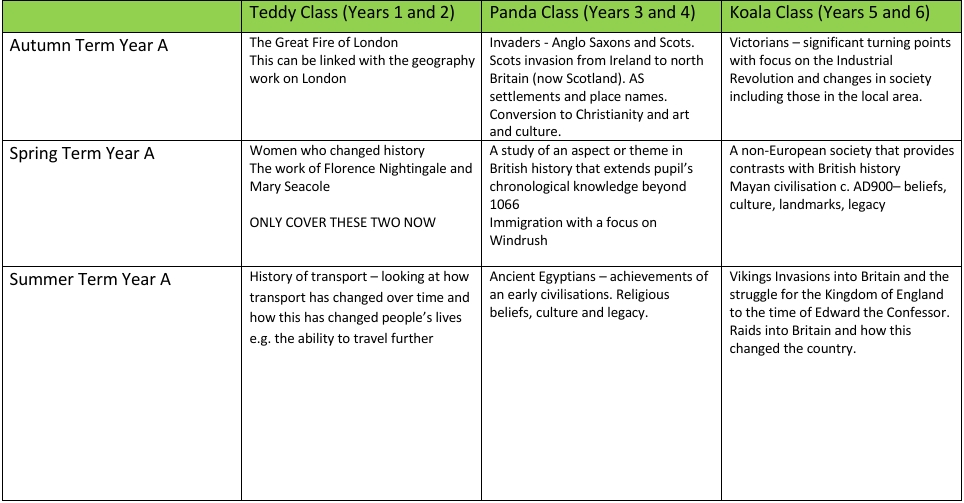
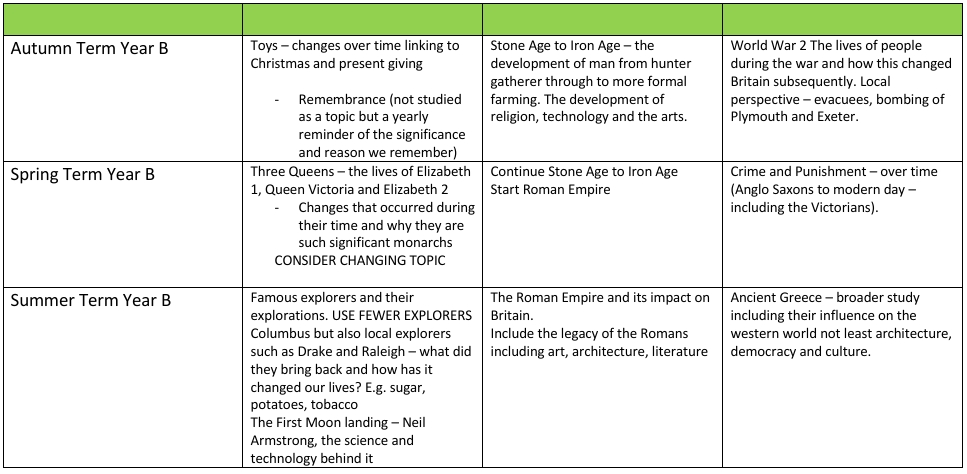
 History Curriculum based on a two year cycle:
NB- Local History Study:

LOCAL HISTORY WEEK in 2026/2027 to coincide with 150 years of school. Whole school week of events looking at different aspects of local history.

The two year plan aims to engage children in to learning about the past and how it has influenced their own lives both now and in the future. As with other subjects, Teddy class (Y1 and 2) cover the KS1 curriculum with Panda and Koala being taught the KS2 syllabus. Children in Reception will work alongside KS1 pupils where it is appropriate (such as the unit of work on toys) and will undertake related activities linked to the early years curriculum.

Many of the themes and people covered in KS1 appear as the children make their way through KS2. The aim is that their prior learning about people such as Queen Victoria or Tim Berners-Lee will support them through the KS2 topics. We have specifically chosen to highlight particular women in history and their historical influence. We are mindful that many periods of history appear to be dominated by male figures, so we are keen to ensure the children are aware of the influence of women too. Similarly, the curriculum will include significant people from cultures and ethnicities that are different to their own. Likewise, the children will learn about the influence of multiculturalism in shaping modern Britain. We want all of the children to have high aspirations in life and be inspired those who have gone before. Similarly, we want the children to be aware of the influence of Devon and Devonians on history (Francis Drake, Nancy Astor, Charles Babbage, the bombing of cities such as Plymouth and Exeter in WW2). It also links to our school houses and again re-enforces the theme of aspiration for all our children. It also allows scope for enriching the curriculum with the opportunity to visit local places of historical significance such as the architecture of Isambard Kingdom Brunel.

Our history curriculum allows the children to build knowledge of other parts of the world and the influence they have had on our lives today. A prime example being the influence of the Romans on the local area including the city of Exeter. This also allows teaching to include aspects of the geography curriculum in identifying countries of the world and how territories and sovereignty change over time. The curriculum also allows for cross curricular links including art, music and design technology.

Through our history curriculum we also aim to ensure that it reflects the diversity that exists, both in the UK and the wider world, over time. As part of this we make the children aware of our colonial past and the impact this had and that it was not always a positive impact. To this end, we also aim to ensure that the children gain an understanding that history is often written from different perspectives and these will sometimes conflict with each other. Similarly, interpretations of history do change over time and the school curriculum tries to reflect this for example, the impact of slavery.

There is a strong emphasis on building knowledge and accumulating this over time and through the study of different periods (not necessarily in chronological order). Where possible we have linked certain topics such as WW1 and 2 so that they coincide with Remembrance commemorations. In addition to the building of pupil knowledge, we aim to see the development of historical skills so that pupils can showing increasing levels of historical analysis and enquiry. Likewise, the children will gain a greater understanding of chronology, context and perspective. This will allow children to develop their historical writing skills and ability to influence their own learning such as the lower KS2 topic of ‘Changes in modern Britain’ where pupils will be encouraged to choose the particular aspects they want to research as part of a pupil led project.

Skip to content